News
Holding North American Manufacturing Together
Barcode Verification 101: Catching Code Quality Issues
Mid-America Packaging | Week #31
Barcode Verification 101: Catching Code Quality Issues
August 5, 2026
A shipment can be packed right. It can ship on time. It can still trigger a barcode rejection at the dock over one thing: a code that will not scan. Barcode verification catches that problem before it leaves your facility. Retailers do not accept “it scanned fine here…” They score every code against a barcode grading system, and they lean on in-line verification data to back up a claim. A low score can trigger chargebacks, delayed receiving, or a rejected pallet.
For operators and purchasing teams, knowing how barcode verification works makes a real difference. It is the gap between shipping with confidence and finding out about a problem from an angry customer email.
What Is Barcode Verification, and How Is It Different From Scanning?
A scanner answers one simple question: can this code be read right now? A barcode verifier asks a harder question. How close is this symbol to a perfect print? Will it still scan on a different device, in different light, next week?
That difference matters. A barcode can scan today on your handheld. It can still fail tomorrow on a retailer’s high-speed conveyor scanner. GS1 measures barcode print quality using the ISO/IEC 15416 standard, and it uses a grading method aligned with ANSI. This barcode grading method scores a symbol from 0 to 4. The score is based on seven optical parameters.
How the ANSI Barcode Grading Scale Works
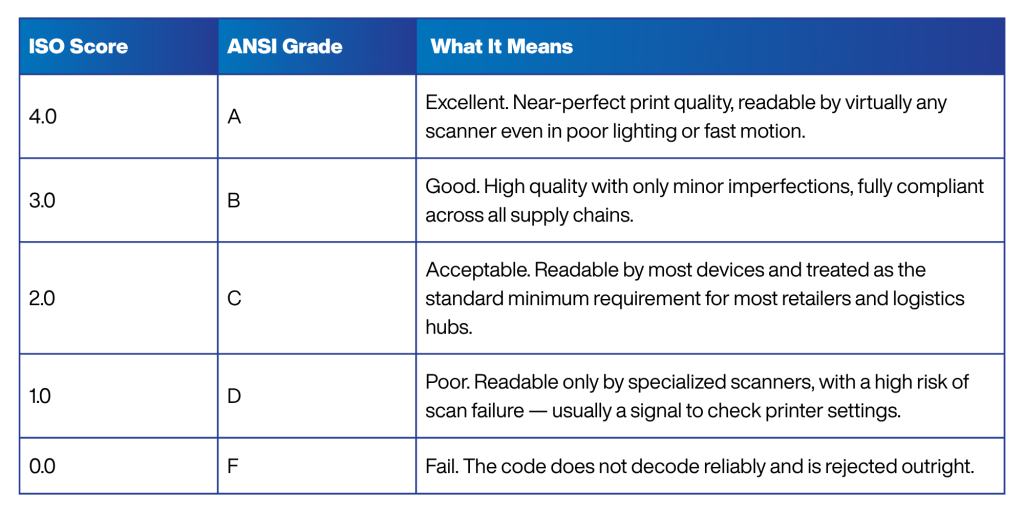
ANSI translates that ISO numeric score into a familiar letter grade: A through F. Grades A through D pass under standard barcode grading rules. Grade F fails outright. GS1 requires barcodes to carry at least an ANSI Grade C, which lines up with ISO Grade 2, by the time a product reaches its best-before date. Most major retailers hold suppliers to that same standard.
Here is where plants get caught off guard. A Grade C barcode is still not a good scan in most barcode grading programs. It is the bare minimum. It may indicate print heads wearing down, ribbons running low, substrate variations, or more. Any of those factors can drag a marginal C into failing territory before your next check.
What Actually Triggers a Barcode Rejection
Barcode rejections rarely come from one dramatic cause. Instead, they build up from small issues over time:
- Low print contrast between bars and background material
- Damage or smudging from handling
- The wrong symbology for a retailer’s requirements
- Poor placement, including tilt or wrong location on the case
- Worn print-heads or degraded ribbon quality on inkjet or thermal systems
Retailers treat these as real problems, not small ones. For example, Walmart’s Supplier Quality Excellence Program charges $5 per carton when unreadable barcodes exceed 1% of a shipment, and $10 per carton once that rate passes 2%, applied to the full shipment rather than just the mislabeled cartons. A handful of weak labels can turn into one costly, full-load fine.
How In-Line Verification Prevents Downstream Chargebacks
This is where equipment, not just procedure, makes the real difference. In-line verification equipment checks every code as it prints. It does not wait for a random spot check at the end of the shift.
For example, Hitachi inkjet vision systems check each printed character on their own. This catches code wear as it happens. The system uses a grading threshold set for your job.
Real-time barcode verification does two things a manual check cannot do. First, it flags a drifting print-head before hundreds of cartons ship with it. Second, it skips over good codes, so it will not flag a code that still passes. Building this in-line verification checkpoint into the line changes everything. Plants that do this rarely see a chargebacks. Plants that treat verification as a final inspection step see them often.
Building a Barcode Verification Checkpoint Into Your Line
Here is a practical starting point for your team:
- Verify barcode grade at the print-head, not just at the case sealer
- Recalibrate verification equipment on a fixed schedule, not only after a rejection
- Track grade trends over time, not just pass or fail results
- Loop in maintenance early, as soon as average grades start slipping toward C
Barcode verification is not a one-time check on a form. It is an ongoing quality signal. It tells you when a printer, ribbon, or print-head needs work, well before a retailer’s scanner tells you first.
Is your team seeing barcode rejections climb? Are you ready to add in-line verification to an inkjet or thermal print system? MAP’s team can help you find the right equipment for your line.
 Click here to contact your Mid-America Packaging representative!
Call: (314) 652-4583 | Email: info@map-pack.com
Follow us on LinkedIn for more tips, resources, and updates!
Sources:
Cognex: Industry and Application Standards for Barcode Verification
Alpha BPO: Barcode Validation: The Prepress Step That Prevents Retail Chargebacks (Walmart SQEP)